Research
From mirror to instrument
The lab’s work runs from device fabrication to the instruments that use it: microelectromechanical deformable mirrors, the control methods that make them precise, and the imaging systems they improve.
MEMS deformable mirrors
A shape-controlled mirror built with semiconductor tools
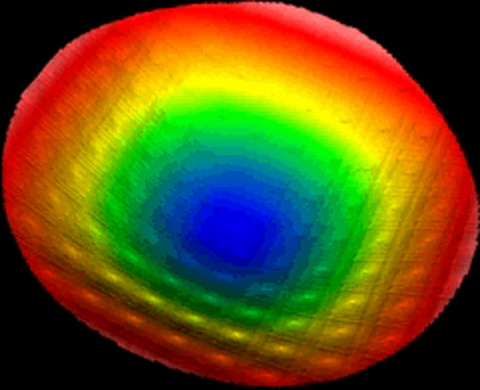
In 1997 the lab reported a continuous-membrane, surface-micromachined silicon deformable mirror: an array of electrostatic actuators beneath a thin polysilicon face sheet, made with standard MEMS foundry processes. Their extraordinary repeatability and scalability is a result of hysteresis-free electrostatic actuation and precise semiconductor manufacturing processes.
The work was supported by DARPA and led by Ph.D. students Raji Mali and Julie Perreault. Later work solved the problems that kept such mirrors from scaling, including stress-induced curvature in thin films, planarization of multilayer structures, integrated drive electronics, and through-wafer interconnects.
Boston Micromachines Corporation, co-founded in 1999 to commercialize the technology, has built mirrors with more than 4,000 actuators. They are used in astronomical instruments such as the Gemini Planet Imager and Subaru’s SCExAO, and in retinal imaging, microscopy, and laser communications.
Key papers
- Bifano, T. G., Mali, R. K., Dorton, J. K., Perreault, J., Vandelli, N., Horenstein, M. N. & Castanon, D. A. Continuous-membrane surface-micromachined silicon deformable mirror. Optical Engineering 36, 1354–1360 (1997). PDFDOI
- Bifano, T. G., Perreault, J., Mali, R. K. & Horenstein, M. N. Microelectromechanical deformable mirrors. IEEE Journal of Selected Topics in Quantum Electronics 5, 83–89 (1999). PDFDOI
- Bifano, T. G., Johnson, H. T., Bierden, P. & Mali, R. K. Elimination of stress-induced curvature in thin-film structures. Journal of Microelectromechanical Systems 11, 592–597 (2002). PDFDOI
- Stewart, J. B., Bifano, T. G., Cornelissen, S., Bierden, P., Levine, B. M. & Cook, T. Design and development of a 331-segment tip–tilt–piston mirror array for space-based adaptive optics. Sensors and Actuators A: Physical 138, 230–238 (2007). PDFDOI
- Cornelissen, S. A., Bierden, P. A., Bifano, T. G. & Lam, C. V. 4096-element continuous face-sheet MEMS deformable mirror for high-contrast imaging. Journal of Micro/Nanolithography, MEMS, and MOEMS 8 (2009). PDFDOI
- Bifano, T. Adaptive imaging: MEMS deformable mirrors. Nature Photonics 5, 21–23 (2011). PDFDOI
- Haber, A. & Bifano, T. General approach to precise deformable mirror control. Optics Express 29, 33741–33759 (2021). PDFDOI
Current project · 2026
Beam steering with segmented mirrors
A segmented MEMS mirror with 37 hexagonal segments steers a 660 nm laser while a camera watches the far field. Tilting all segments together steers one beam. Assigning segments to groups splits the light into several beams that can be pointed independently, and the way segments are assigned controls where the stray light goes.
The motion in the video, made by Ph.D. student Nate Hart, is slowed down for viewing. The mirror itself moves in tens of microseconds.
Adaptive optics for imaging
Seeing deeper into tissue
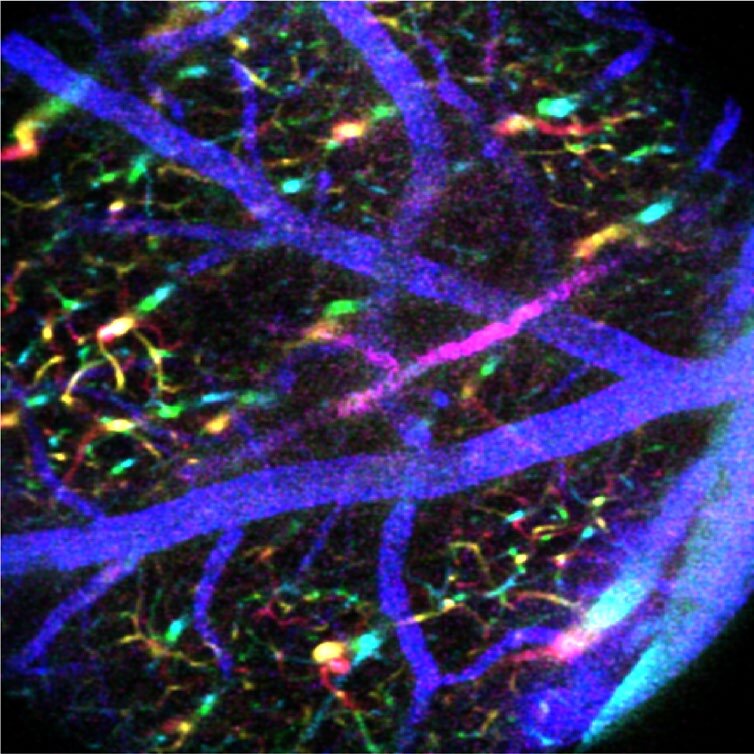
Biological tissue scrambles light. With collaborators in biomedical engineering, physics, and neuroscience, the lab uses deformable mirrors to measure and undo those distortions: conjugate adaptive optics that widen the corrected field of view, focusing through strongly scattering media, adaptive multiphoton microscopy, extended depth-of-field imaging, and reverberation microscopy that images many planes at once. A related line of work applied deformable mirrors to solid-immersion microscopy of integrated circuits.
Key papers
- Stockbridge, C., Lu, Y., Moore, J., Hoffman, S., Paxman, R., Toussaint, K. & Bifano, T. Focusing through dynamic scattering media. Optics Express 20, 15086–15092 (2012). PDFDOI
- Paudel, H. P., Stockbridge, C., Mertz, J. & Bifano, T. Focusing polychromatic light through strongly scattering media. Optics Express 21, 17299–17308 (2013). PDFDOI
- Li, J., Beaulieu, D. R., Paudel, H., Barankov, R., Bifano, T. G. & Mertz, J. Conjugate adaptive optics in widefield microscopy with an extended-source wavefront sensor. Optica 2, 682–688 (2015). PDFDOI
- Mertz, J., Paudel, H. & Bifano, T. G. Field of view advantage of conjugate adaptive optics in microscopy applications. Applied Optics 54, 3498–3506 (2015). PDFDOI
- Beaulieu, D. R., Davison, I. G., Kılıç, K., Bifano, T. G. & Mertz, J. Simultaneous multiplane imaging with reverberation two-photon microscopy. Nature Methods 17, 283–286 (2020). PDFDOI
- Rodríguez, C., Chen, A., Rivera, J. A., Mohr, M. A., Liang, Y., Natan, R. G., Sun, W., Milkie, D. E., Bifano, T. G., Chen, X. & Ji, N. An adaptive optics module for deep tissue multiphoton imaging in vivo. Nature Methods 18, 1259–1264 (2021). PDFDOI
- Lu, Y., Bifano, T., Ünlü, M. S. & Goldberg, B. Aberration compensation in aplanatic solid immersion lens microscopy. Optics Express 21, 28189–28197 (2013). PDFDOI
Engineered heart tissue
Instruments for cardiac tissue engineering
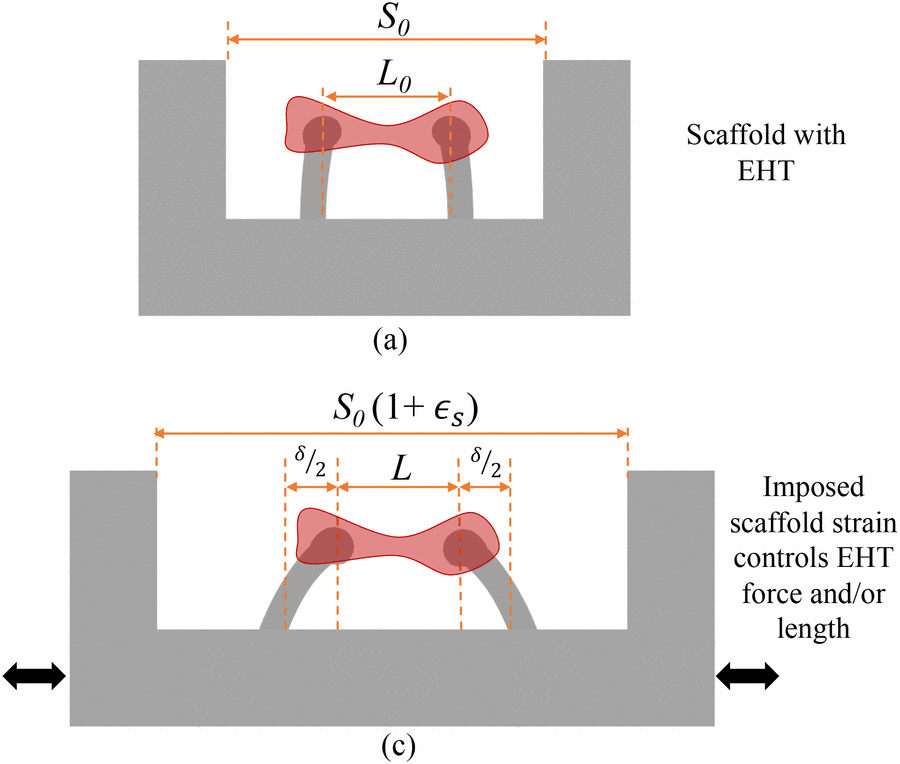
As part of the NSF Engineering Research Center for Cellular Metamaterials (CELL-MET), whose goal is engineered heart tissue for cardiac repair, the lab builds tools to grow, stimulate, and measure small engineered cardiac tissues: a high-throughput screening system (US Patent 12,436,317), closed-loop control of contractile force, and a platform for combined electrical and mechanical stimulation.
Key papers
- Ma, M. S., Sundaram, S., Lou, L., Agarwal, A., Chen, C. S. & Bifano, T. G. High throughput screening system for engineered cardiac tissues. Frontiers in Bioengineering and Biotechnology 11 (2023). PDFDOI
- Li, H., Sundaram, S., Hu, R., Lou, L., Sanchez, F., McDonald, W., Agarwal, A., Chen, C. S. & Bifano, T. G. Dynamic Control of Contractile Force in Engineered Heart Tissue. IEEE Transactions on Biomedical Engineering 70, 2237–2245 (2023). PDFDOI
- Hu, R., Varela, C. E., Karakan, M. Ç., Sanchez, F., Wolking, B., Chen, C. S. & Bifano, T. G. A biophysical platform for electromechanical stimulation of engineered cardiac tissues. bioRxiv (2026). DOI
- Ewoldt, J. K., DePalma, S. J., Jewett, M. E., Karakan, M. Ç., Lin, Y.-M., Mir Hashemian, P., Gao, X., Lou, L., McLellan, M. A., Tabares, J., Ma, M., Salazar Coariti, A. C., He, J., Toussaint, K. C., Bifano, T. G., Ramaswamy, S., White, A. E., Agarwal, A., Lejeune, E., Baker, B. M. & Chen, C. S. Induced pluripotent stem cell-derived cardiomyocyte in vitro models: benchmarking progress and ongoing challenges. Nature Methods 22, 24–40 (2024). PDFDOI
Where it started
Precision machining of brittle materials
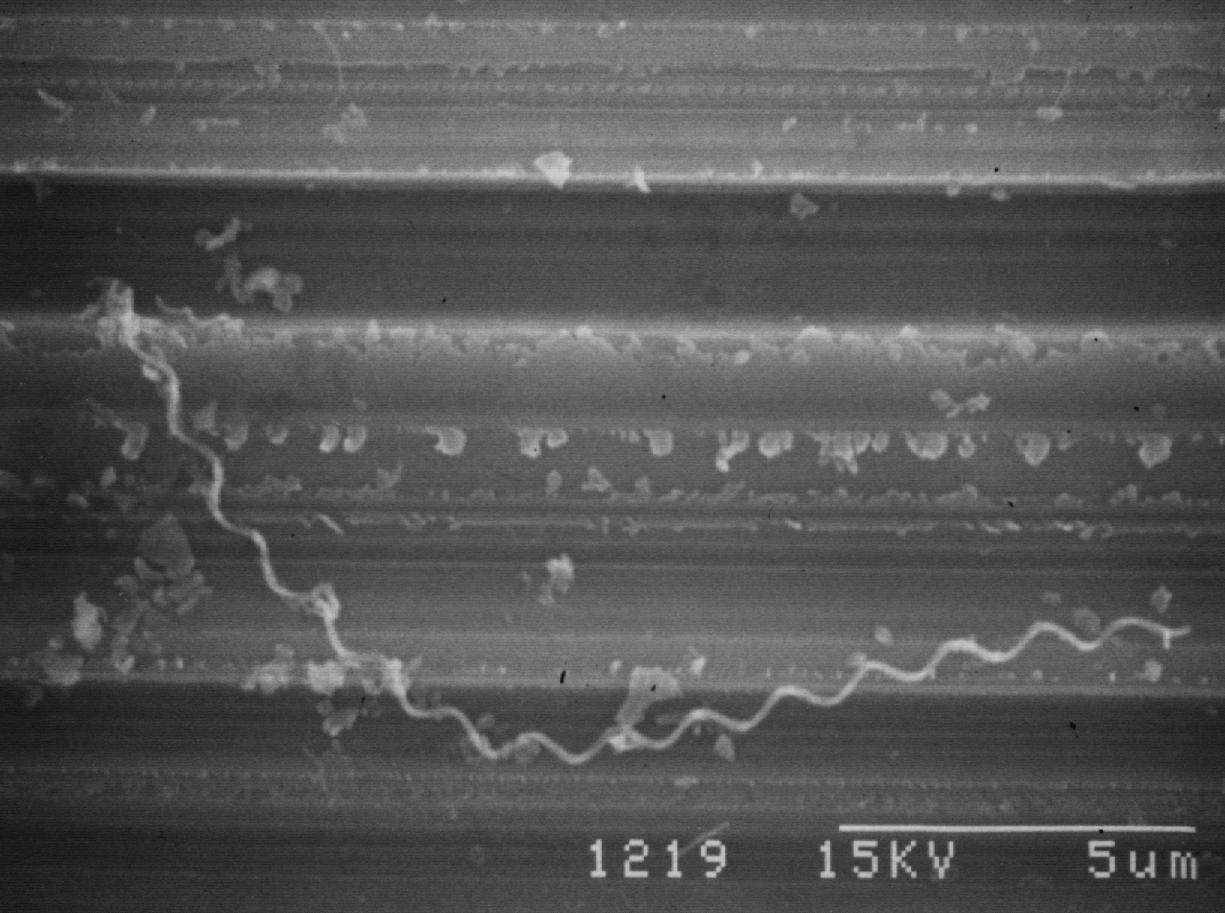
The lab began in precision engineering. Ductile-regime grinding showed that glass and ceramics can be machined without fracture when the depth of cut stays below a critical value, a result that is still widely used. Later work covered in-process control of grinding, ion-beam figuring of optics, and manufacturing of optical disc stampers. The same nanometer-scale control of material behavior underlies the mirror work.
Key papers
- Bifano, T. G., Dow, T. A. & Scattergood, R. O. Ductile-Regime Grinding: A New Technology for Machining Brittle Materials. Journal of Engineering for Industry 113, 184–189 (1991). PDFDOI
- Bifano, T. G. & Fawcett, S. C. Specific Grinding Energy as an In-Process Control Variable for Ductile-Regime Grinding. Precision Engineering 13, 256–262 (1991). PDFDOI
- Drueding, T. W., Fawcett, S. C., Wilson, S. R. & Bifano, T. G. Ion beam figuring of small optical components. Optical Engineering 34, 3565–3571 (1995). PDFDOI